

UN big bags
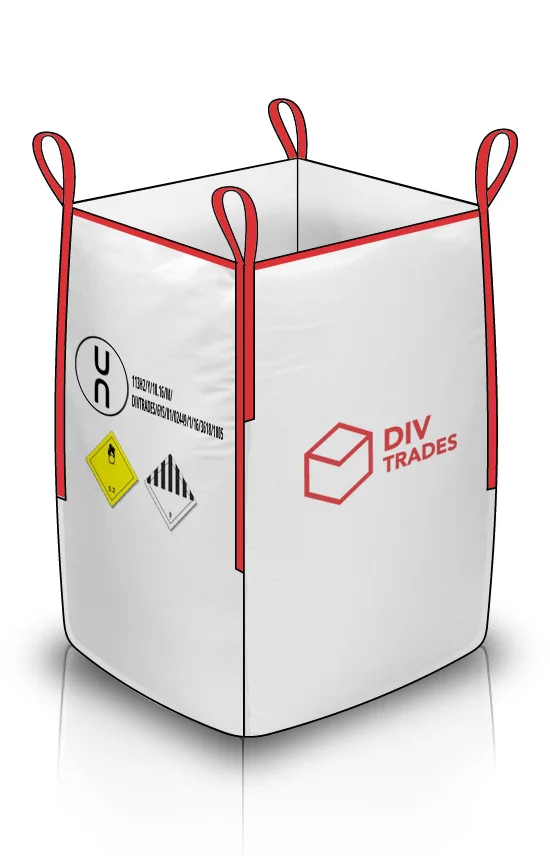
UN-approved FIBC for packing dangerous goods: extra-strong construction, independent testing and the ADR certificate handed over with every design.
Quick facts
- Packing groups II (Y) and III (Z), up to 3.0 m³
- 13H1, 13H2, 13H3 and 13H4 designs
- Tested by an independent test house; ADR certificate supplied
- Single trip only, closed inlet (spout or skirt)
- Height not more than twice the shortest side
UN big bags are FIBC that comply with the United Nations Recommendations on the Transport of Dangerous Goods and the European ADR agreement. Compared with standard FIBC they are built extra strong so the contents cannot leak even when the bag is dropped, toppled or stacked, and every design is tested by an independent test house. DIV Trades supplies UN bags of types 13H1 to 13H4 for packing groups II and III with a volume of up to 3.0 m³, and hands the ADR certificate over to the buyer.
Background: UN Recommendations and ADR
The UN Recommendations define how strong a big bag for dangerous goods must be and how it has to be tested. Most European countries have signed the European Agreement concerning the International Carriage of Dangerous Goods by Road (ADR), which adopts these recommendations.
UN packing groups
| Packing group | UN symbol | Degree of danger | Max. volume | Offered by DIV Trades |
|---|---|---|---|---|
| I | X | High | 1.5 m³ | No (not possible for FIBC) |
| II | Y | Medium | 3.0 m³ | Yes |
| III | Z | Low | 3.0 m³ | Yes |
Do I need a UN bag for my product?
That depends on the goods and the legislation of the countries involved. The UN list of dangerous goods gives a first indication; your safety adviser or the carrier will confirm the packing group. If you are unsure, contact our sales team with the UN number of your product.
Construction of UN big bags
13H1
Uncoated woven PP fabric, without inliner.
13H2
Coated woven PP fabric, without inliner.
13H3
Uncoated woven PP fabric, with inliner.
13H4
Coated woven PP fabric, with inliner.
UN bags have a stated SWL and a maximum stacking load but no safety factor in the usual sense; they are always single-trip bags. Their design is limited in a few ways:
- Size: the bag must not be higher than twice its shortest side and cannot have a volume above 3.0 m³.
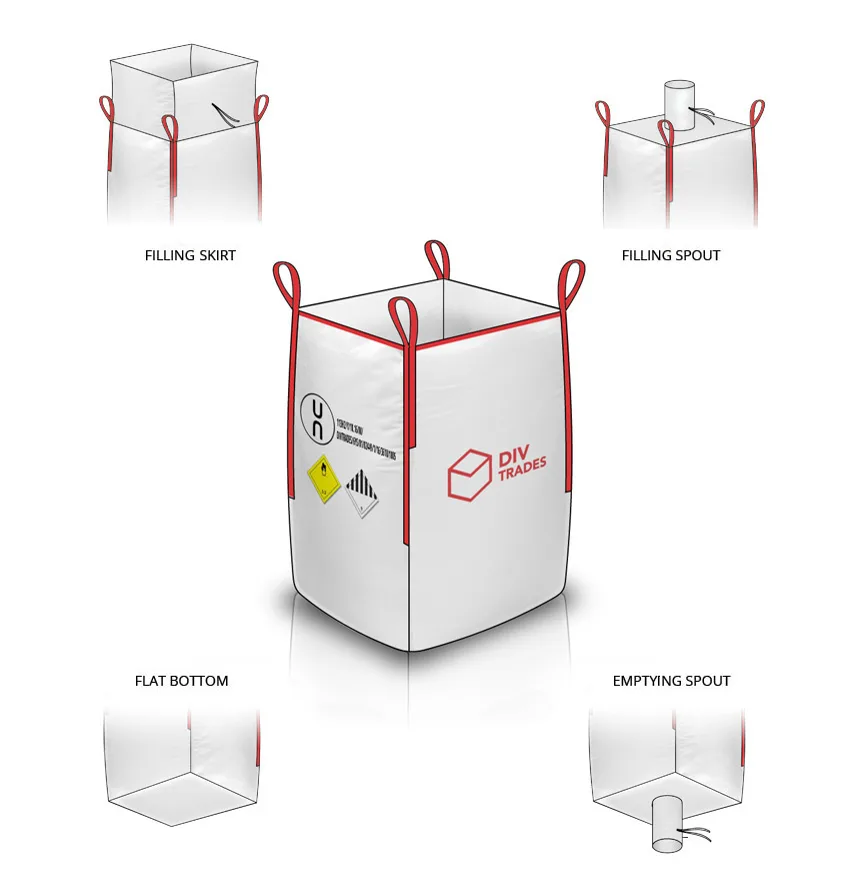
- Inlet: an open top or a simple flap closure is not allowed; the top must be closed with an inlet spout or a skirt so the goods stay inside if the bag tips over. See filling options.
- Use: UN bags cannot be repaired and may be used only once.
- Perimeter belt: UN bags can carry an additional belt around the top of the bag; see lifting options.
UN construction can be combined with other types: formstable, conductive Type C, one- and two-loop and lined bags.
Marking of UN bags
Every UN bag design carries a unique UN code that identifies the bag type, packing group, maximum gross mass, year of manufacture, country and the manufacturer. In addition, UN FIBC must show a stacking load pictogram; optional ADR danger signs can be printed on request.


How UN bags are tested
- 1
Top lift test
The bag is loaded with six times its maximum gross mass and held for 5 minutes. It must show no damage.
- 2
Stacking test
The bag is filled to its maximum allowable gross mass, then 1.8 times the maximum stacking load is placed on top for 24 hours. No deterioration of the body or loss of contents is allowed.
- 3
Drop test
The bag is filled to its maximum permissible gross mass and dropped from 1.2 m for packing group II or 0.8 m for packing group III. No loss of contents is allowed.
- 4
Tear test
A 10 cm cut is made with a knife into the fully loaded bag. Twice the maximum gross load is applied for 5 minutes and the bag is then lifted for 5 minutes. The cut must not grow by more than 25%.
- 5
Topple test
The bag is toppled from 1.2 m for packing group II or 0.8 m for packing group III. No loss of material is allowed.
- 6
Righting test
The bag, filled to its maximum permissible mass and lying on its side, is lifted to the upright position at 0.1 m/s. It must show no damage.
What is a UN big bag?
An FIBC designed, tested and certified according to the UN Recommendations on the Transport of Dangerous Goods, marked with a UN code and approved for solid dangerous goods of packing group II or III.
What do 13H1, 13H2, 13H3 and 13H4 mean?
13H is the UN code for a flexible IBC made of woven plastic. The digit states the construction: 1 uncoated without liner, 2 coated without liner, 3 uncoated with liner, 4 coated with liner.
Can UN bags be reused or repaired?
No. UN bags are single-trip packaging and must not be repaired or reused.
Who tests the bags?
Every UN bag design is tested by an independent test house. The ADR certificate is handed over to the buyer with the bags.
Can a UN bag have an open top?
No. The top must be closed with an inlet spout or a skirt so that the dangerous goods stay inside if the bag tips over.
Can a UN bag also be formstable or conductive?
Yes. UN bags can be built as Q-bags, as Type C conductive bags, with inliners or as one- and two-loop bags, as long as the design passes the UN tests.
Request a quote for UN big bags
Send us the UN number and packing group of your product, the required volume and SWL, and we will propose a certified 13H design.
Request a quote