

Big bags with inliners
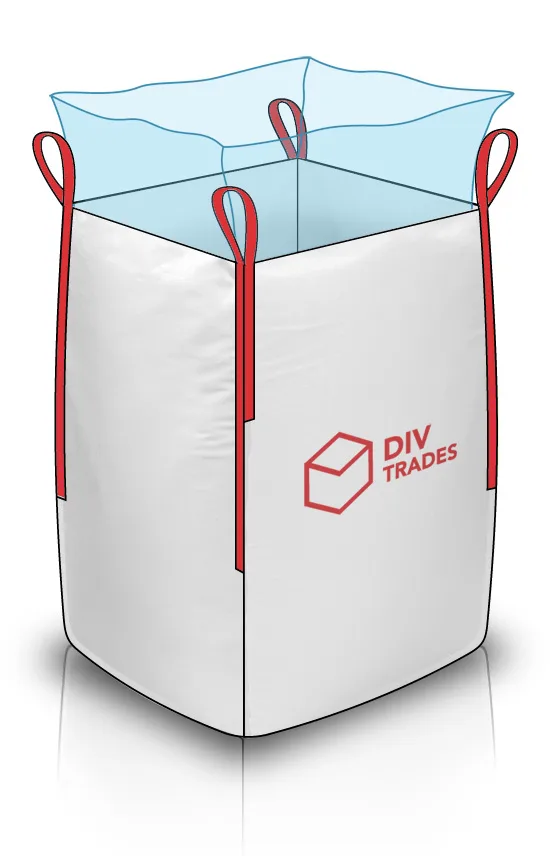
A PE liner inside the woven bag gives the highest level of dust and moisture protection. Choose the liner shape and attachment that fits your product and your filling line.
Quick facts
- Liner thickness 60-120 µm, usually 80 µm above 1,000 kg
- 100% virgin LDPE, transparent or blue
- Tube liner, formliner or Q-liner
- Loose, tabbed, sewn-in or glued attachment
- Conductive liners for Type B and Type C bags
A big bag with an inliner is an FIBC with a polyethylene (PE) liner inside the woven polypropylene body. The liner covers the whole inside of the bag, so the product never touches the fabric or the seams. It is the right choice for very fine powders, hygroscopic materials and liquids, where even three-strip dustproof sewing cannot stop leakage or moisture. DIV Trades fits liners of 60 to 120 µm in tube, bottle (formliner) and baffle (Q-liner) shapes.
Inliner shapes
PE tube liner
A tubular liner welded at the bottom. The most economical shape, but it does not follow the spouts, and wrinkles at the inlet or outlet can slow the material flow.
Formliner
A liner welded in the shape of a bottle that follows the bag and its spouts. Material flows smoothly through the inlet and outlet.
Q-liner
A liner with PE baffles welded inside, which makes the lined bag a formstable Q-bag at the same time. A premium, cost-intensive solution.

How the liner is attached to the bag
Loosely inserted
The liner is simply placed inside the bag. The most cost-efficient option, mostly chosen for simple bags such as fertilizer big bags.
- Lowest cost
- Liner can shift during filling and discharging
Fixed with tabs
The liner is held by eight tabs in the eight corners of the bag, which effectively prevents it moving inside the bag.
- Liner stays in place
Sewn along the entire length
The liner is sewn into all four side seams over the full height of the bag. A firmer fixing than tabs.
- Firmer fixing than tabs
- No movement of the liner
Glued
The liner is glued to the walls of the bag. The firmest attachment and the most expensive option.
- Firmest attachment
- Highest cost

Inliner at the inlet and outlet
The inlet and outlet of a lined bag can be a spout, a skirt or any other variant from our filling options and discharging options. The liner itself can be finished at the inlet and outlet in four ways:
- Open liner, not sewn to the fabric
- Welded liner, not sewn to the fabric
- Liner sewn to the fabric
- Liner sewn and hemmed
Technical characteristics of the inliner
| Property | Standard | Options |
|---|---|---|
| Thickness | 80 µm for bags above 1,000 kg | 60-120 µm depending on product and use |
| Material | 100% virgin LDPE | Other materials on request |
| Color | Transparent | Blue or other colors |
| Dimensions | Derived from the bag dimensions | Formliner shaped to the spouts |
Special inliners
- Conductive liners: Type B and Type C conductive big bags use an electro-conductive inliner.
- Liners for one- and two-loop bags: almost always used, with a special shape for the tubular body.
- Food-contact liners: foodclean big bags can be lined to meet the cleanliness requirements of the food industry.

When do I need an inliner instead of dustproof sewing?
For very fine powders, liquids and products that must not absorb moisture. Dustproof sealing strips stop most fine materials, but a PE liner is the only construction that keeps the product completely away from fabric and seams.
How thick should the liner be?
Usually 80 µm for bags carrying more than 1,000 kg. Depending on the product and purpose DIV Trades fits liners from 60 to 120 µm.
What is a formliner?
A formliner is a PE liner welded in the shape of a bottle so it follows the inlet and outlet spouts of the bag. It avoids the wrinkles of a plain tube liner and gives a smooth material flow.
Should the liner be loose or fixed?
A loose liner is cheapest and is common for fertilizer. If the liner must not move during filling and discharging, choose tabbed, sewn-in or glued attachment.
Can a lined bag also be a Q-bag?
Yes. Either as a Q-liner with PE baffles inside the liner, or as a baffle bag with a separate liner, or as a bag-in-bag construction.
Request a quote for big bags with inliners
Tell us your product and how you fill and empty the bag and we will propose the liner shape, thickness and attachment that fits.
Request a quote