

Big bags (FIBC): types and specifications
Every major big bag type on the market, produced in Bačka Palanka, Serbia, and every option you need to specify one. Most types can be combined in a single bag.
Big bag types
The eight big bag types below cover the market and are all produced by DIV Trades. Most of them can be combined: one bag can be formstable, conductive, foodclean, UN certified and equipped with an inliner at the same time.
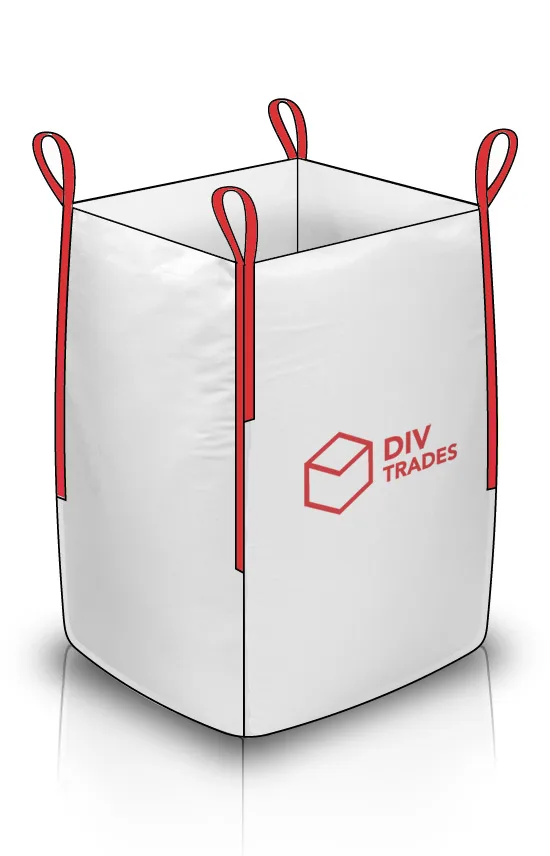
Standard four-loop big bags
The most common FIBC: a woven polypropylene body, four corner loops and a made-to-order top, bottom, fabric and size. Most of the 2 million big bags DIV Trades makes a year are standard four-loop bags.
Read more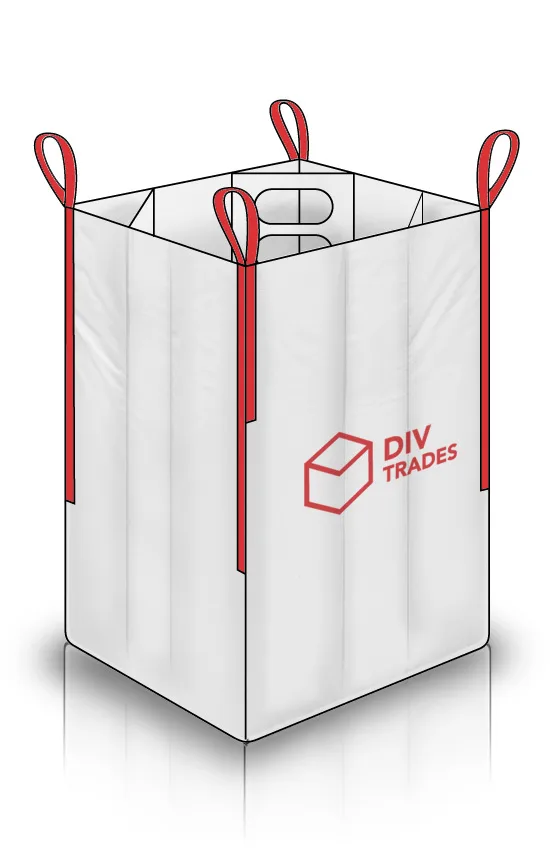
Formstable big bags (Q-bags)
Baffle big bags with internal diagonal panels that keep the FIBC square when filled: no belly, stable stacking, within pallet edges and up to 25% less space in transport and storage.
Read more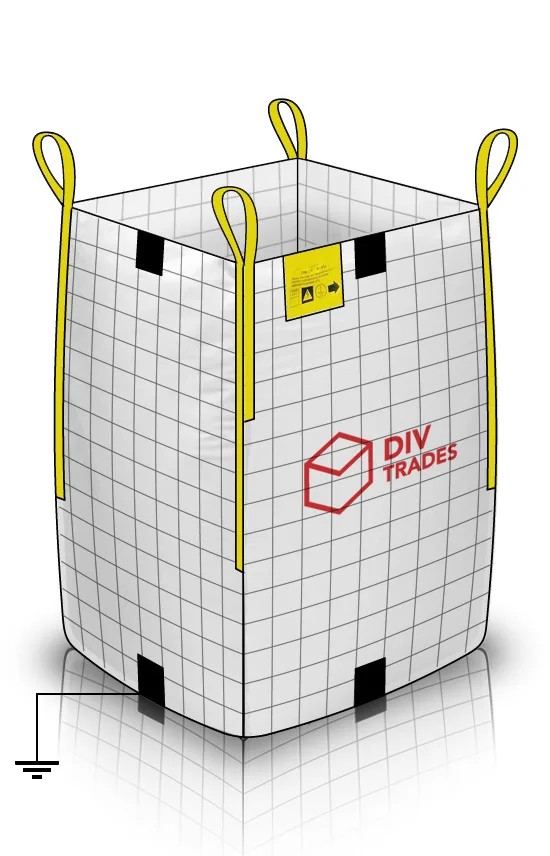
Conductive big bags (Type C)
Antistatic and conductive FIBC (Type B and Type C to IEC 61340-4-4) for flammable powders and explosive atmospheres: carbon threads woven into the fabric, grounding points and tested conductivity.
Read more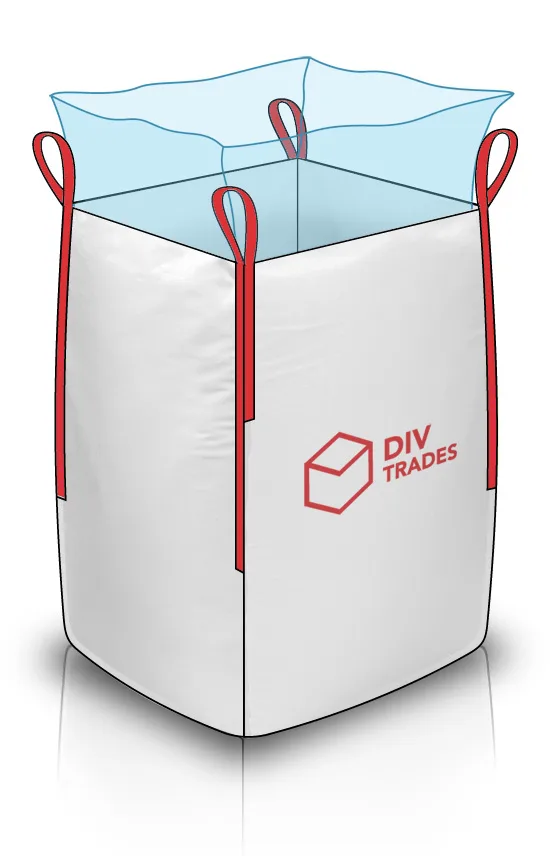
Big bags with PE inliners
FIBC with a polyethylene liner that covers the whole inside of the bag, so fine powders, hygroscopic products and liquids never touch fabric or seams. Tube liners, formliners and Q-liners, loose, tabbed, sewn or glued.
Read more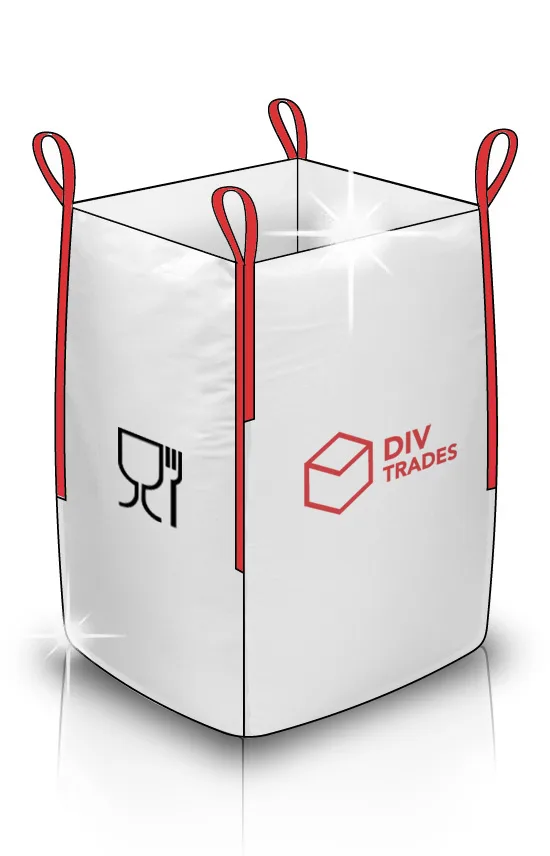
Foodclean big bags for the food industry
Food-grade FIBC for sugar, milk powder, flour and starch, produced under HACCP and ISO 22000:2018 and compliant with Regulation (EC) 1935/2004, 10/2011 and 2023/2006. Around 800,000 bags a year go to the sugar industry alone.
Read more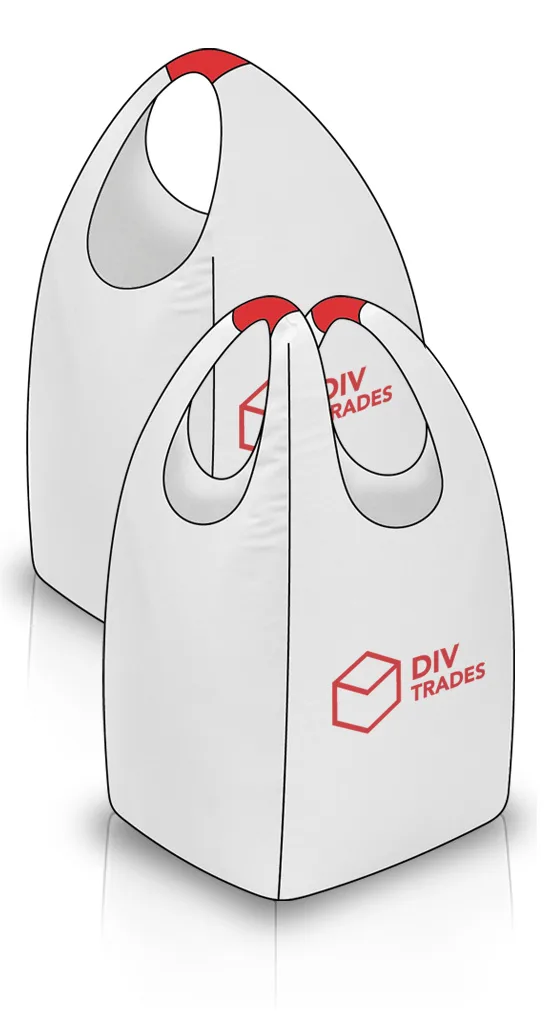
One- and two-loop big bags
Single- and double-loop FIBC made from one piece of tubular fabric: lifted by hook without a forklift, the most economical bag per kg carried. Standard for fertilizer and chemicals, usually with a PE liner.
Read more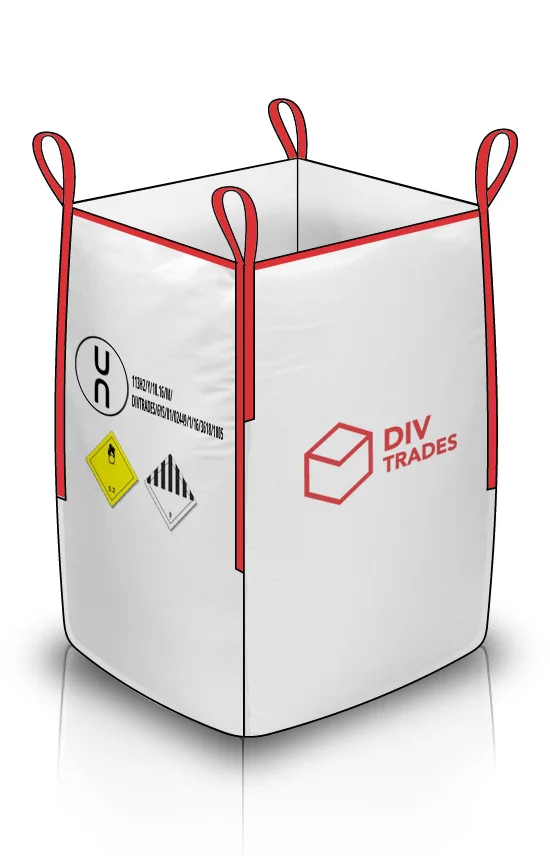
UN big bags for dangerous goods
UN-certified FIBC (13H1-13H4) for packing groups II and III, tested by an independent test house to the UN Recommendations and ADR: extra strong, leak-tight, single use, up to 3.0 m³.
Read more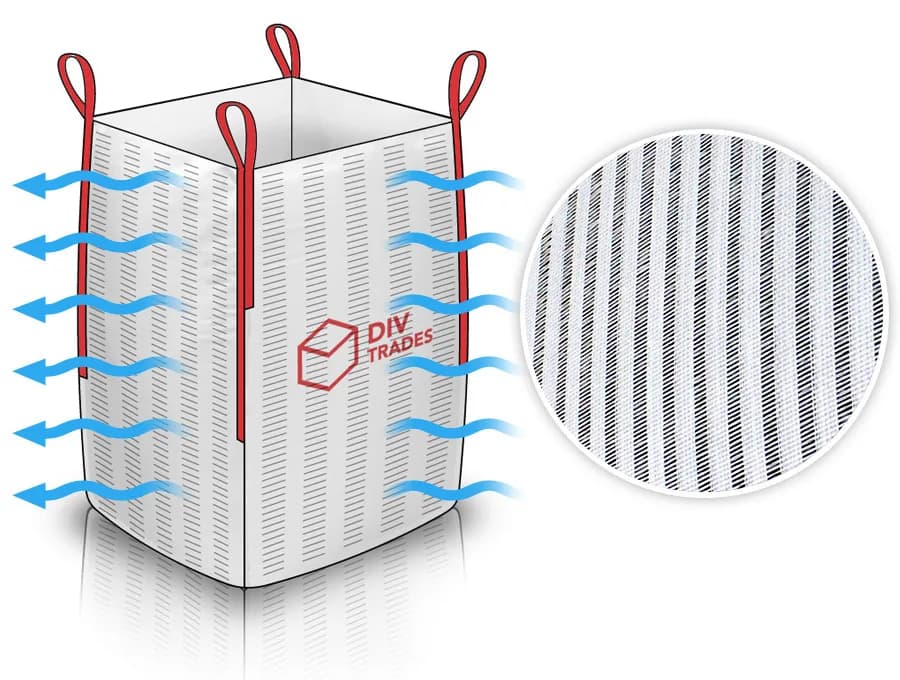
Ventilated big bags
Breathable FIBC woven with ventilation strips so air circulates through the bag and moisture escapes. Keeps potatoes, onions and wood dry in storage and transport; about 2 m high for 1,000 to 1,250 kg.
Read moreBig bag specifications
Almost every big bag is made to the customer's requirements, so a large number of styles and options exist. After nearly three decades of FIBC manufacturing DIV Trades is familiar with all of them. Use the specification pages to decide on loops, inlet, outlet, SWL, dimensions, fabric, dustproof level, printing and document pocket.
 Lifting optionsFour corner loops are the FIBC standard, but cross-corner, one- and two-loop, tunnel, stevedore and bottom loops are available for every handling method.
 Filling optionsOpen top, flap, skirt, inlet spout, spout with flap and conical top: the big bag inlet decides how fast you fill and how well the product is protected.
 Discharging optionsFlat bottom, outlet spout, bottom skirt or conical bottom: the bottom design of a big bag determines how it is emptied, how fast and whether it can be closed again.
 SWL and safety factorEvery big bag is built for a safe working load (SWL), typically 500 to 2,000 kg, and a safety factor of 5:1 for single-trip or 6:1 for multi-trip use.
 DimensionsBig bag dimensions are driven by product density, truck and pallet sizes and the filling line. 91 × 91 cm and 95 × 95 cm bases fill a truck to 24 or 25 tonnes.
 FabricBig bag bodies are woven PP fabric of 140 to 240 g/m², coated or uncoated, white as standard and UV-stabilized to 150 kly. All of it is woven by DIV Trades.
 Dustproof sealing and sewingFrom plain seams for granules to three sealing strips for milk powder, an inliner or a bag-in-bag: choose the dustproof level and seam type your product needs.
 PrintingDIV Trades flexo-prints big bags in up to three colors per pass, up to 1,000 × 1,900 mm, with Pantone-matched inks: logos, product names, warnings and handling instructions.
 Document pocketA document pocket in A4 or A5, sewn to the top or side seam, holds delivery notes and labels. Choose the number, position, orientation, opening and an optional zip.
 Individual designsIf you can imagine it, we can sew it. DIV Trades develops custom FIBC with its customers, from unusual dimensions to special inlets, outlets, loops and liners.
What is a big bag (FIBC)?
A big bag is a large sack made from woven polypropylene fabric with lifting loops, used to pack, store and transport dry bulk materials. The technical term is flexible intermediate bulk container, or FIBC; other common names are bulk bag (especially in the UK), jumbo bag, jumbo sack and PP woven container bag. A big bag holds about 1 to 2 m³ and carries up to 2,000 kg, yet costs only a few euros per piece.
Big bags are usually made to each customer's individual specification so they fit the product, the filling line and the transport exactly. Bags for a particular industry are often similar, which is why the type pages and the industries overview are a good starting point. DIV Trades produces around 2 million big bags a year, exports to around 30 countries and ships a full truck of made-to-order bags anywhere in Europe within 3-4 weeks.
How to design your big bag
Big bags are not stock items; they are produced for every customer according to individual requirements. Before you ask for a quote, think about the six basic questions our sales team will ask you:
- 1
What will you fill into the FIBC?
The product decides almost everything else: its bulk density, how fine or dusty it is, whether it is food, flammable, dangerous or needs ventilation. See the industries page for typical constructions.
- 2
What dimensions should the big bag have?
Base and height follow from the product density, the target weight per bag and your pallets, racks and trucks. The most common bases are 91 × 91 and 95 × 95 cm; see dimensions.
- 3
How much weight will the big bag carry?
Choose the safe working load (SWL), usually 500 to 2,000 kg, and whether the bag is single trip (SF 5:1) or multi trip (SF 6:1). See SWL and SF.
- 4
Should the bag be dustproof and the fabric coated?
Granular goods need plain sewing; fine powders need one to three sealing strips, coated fabric or a PE liner. See fabric and dustproof and sewing.
- 5
How should the top be constructed?
Open top, skirt, inlet spout, spout with flap or conical top, depending on your filling machine and the protection the product needs. See filling options.
- 6
How should the bottom be constructed?
Flat bottom, outlet spout, skirt or conical bottom, depending on how your customer empties the bag. See discharging options.
Not sure yet?
If you have thought about these questions, contact our sales team and we will finalize the design with you. For special requests, from printing to document pockets to unusual loops, see the individual design page. A few common standard bags are also available from stock.
Combining big bag types
The type pages describe one feature at a time, but real bags combine them. A sugar bag is typically a foodclean standard bag with one sealing strip; a milk powder bag is often a foodclean formstable bag with three sealing strips or a liner; a bag for a flammable chemical can be a Type C UN bag with a conductive inliner. Tell us the application and we will combine the right features.
What is an FIBC?
FIBC stands for flexible intermediate bulk container: a large sack made from woven polypropylene fabric with lifting loops, used for dry bulk goods. Big bag, bulk bag and jumbo bag are other names for the same product.
How much can a big bag carry?
Big bags are made for safe working loads from 500 to 2,000 kg. The most common SWL values are 1,000 and 1,250 kg, which fill a standard truck to 24 or 25 tonnes.
What is SWL?
SWL is the safe working load, the maximum weight the big bag is designed and tested to carry. It is stated on the label of every bag together with the safety factor.
What is the difference between a one-way and a multi-trip big bag?
A one-way bag is used once and has a safety factor of 5:1, meaning it withstands five times its SWL in the test rig. A multi-trip bag is built stronger with a safety factor of 6:1 and can be returned and refilled a limited number of times with the same product.
How long does delivery take?
A full truck of made-to-order big bags usually ships within 3-4 weeks to any destination in Europe. Some standard sizes are available from stock.
Request a quote for your big bags
Tell us what you pack, how much and how you fill and empty the bag. Our sales team answers in English, German and Serbian.
Request a quote