

One- and two-loop big bags
Use single- and double-loop FIBC for easy handling without a forklift and the best price per tonne packed. The standard bag for fertilizer, urea and bulk chemicals.
Quick facts
- SWL 500-1,500 kg at SF 5:1 or 6:1
- Body and loops from one piece of tubular fabric, 90-200 g/m²
- Bases 60 × 60 to 95 × 95 cm, height 50-200 cm
- Several bags lifted at once by hook or crane
- Loose or suspended PE liner, 60-90 µm
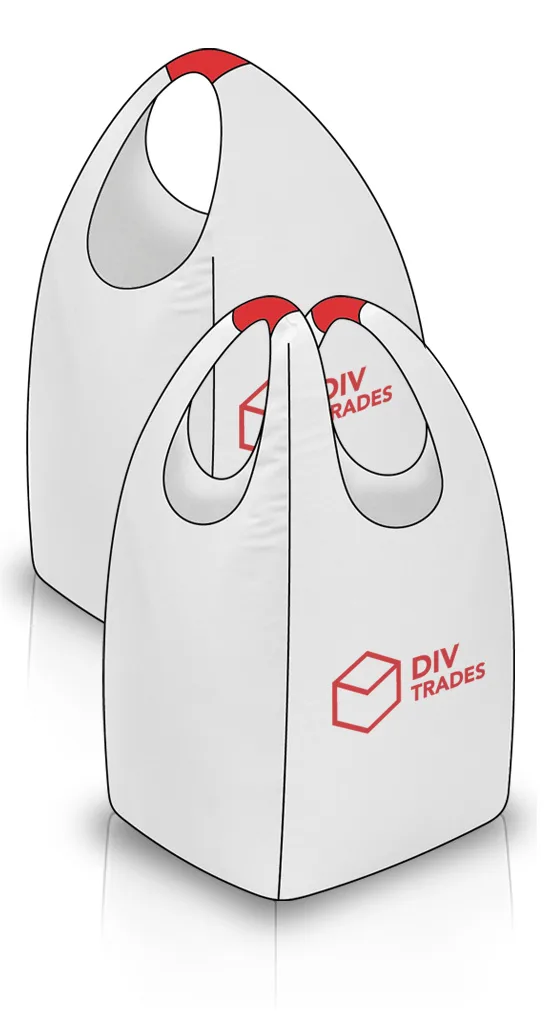
One- and two-loop big bags are FIBC whose body and lifting loops are made from a single piece of tubular woven polypropylene fabric. They are lifted by a hook, crane or simple lifting device instead of a forklift, several bags at a time, and carry a safe working load of 500 to 1,500 kg. DIV Trades produces them in Serbia mainly for fertilizer such as urea and for the chemical industry, almost always with a PE inliner and printed with the customer's brand.
Advantages of single- and double-loop FIBC
- A special solution for handling and storing bulk materials where no forklift is available, for example on farms.
- One or more bags can be lifted at the same time with a hook or a similar device, whereas a four-loop bag usually needs a forklift and is handled one at a time.
- Easier loading of ships and railway wagons where no forklift can be used.
- The most economical big bag: the best price-to-carrying-weight ratio of all FIBC types.
What are one- and two-loop big bags used for?
Mostly for packing fertilizer (for example urea) and products of the chemical industry. They are also used for grain, seeds, briquettes, pellets, cement and other materials; see our industries overview.
Construction
Body and lifting loops
Body and loops are one piece of tubular fabric of 90 to 200 g/m², so there is no difference between internal and external dimensions. Around the top of the loop another piece of fabric is wrapped; it can be made in any color to identify the packed material at a glance. Because the body is a tube, this type cannot be built as a formstable Q-bag.
One loop or two loops?
Both are available. Choose the version supported by your filling machine and the lifting equipment at your customers; see lifting options.
Top
The top can be an open top, an inlet spout or a top skirt. The most common construction is an open top combined with an inliner that is tied closed after filling.
Bottom
The bottom is either a separate square piece of fabric or sewn as a star from the body fabric. All bottom types are possible, from flat bottom to discharge spout; see discharging options.
Dimensions and carrying weight
| Parameter | Range |
|---|---|
| Standard bases (width × length) | 60 × 60, 62.5 × 62.5, 75 × 75, 80 × 80, 85 × 85, 90 × 90 and 95 × 95 cm |
| Bag height (bottom to start of loop) | 50-200 cm |
| Loop height | 20-70 cm |
| SWL | 500-1,500 kg; for fertilizer usually 500, 600, 750 or 1,000 kg |
| Safety factor | 5:1 single trip or 6:1 multi trip |
Other dimensions are produced on request. One- and two-loop bags can also be constructed as UN bags for dangerous goods. What SWL and SF mean is explained under SWL and SF.
Inliners for one- and two-loop bags
A PE inliner of 60 to 90 µm is usually placed inside the bag to protect the goods from moisture and to prevent leakage. Coated fabric and dustproof sewing are possible but less common for this bag type.
Loosely inserted tubular liner
The most common and most economical liner for fertilizer producers: welded at the bottom, open at the top and closed with a tie after filling.
Loosely inserted valved tubular liner
Like the tubular liner but also welded at the top, with a filling hole in one top corner.
Loosely inserted formliner
Welded in the shape of a bottle that forms the inlet and/or outlet spout.
Suspended formliner
A formliner fixed at the loops, so the liner cannot move inside the bag.

Printing
One- and two-loop bags are printed to the customer's design with company name, logo, product information and handling instructions. For fertilizer bags the print is part of the brand on the farm, so DIV Trades treats print quality as seriously as bag quality; see printing.

How are one-loop big bags lifted?
By a hook, crane, tractor front loader or similar device through the single loop. Several bags can be lifted at once, and no forklift is needed.
How much can a one- or two-loop big bag carry?
Between 500 and 1,500 kg with a safety factor of 5:1 or 6:1. Fertilizer bags are usually 500, 600, 750 or 1,000 kg.
Do one- and two-loop bags need an inliner?
Almost always, yes. A 60-90 µm PE liner protects the fertilizer or chemical from moisture and leakage; coated fabric and dustproof sewing are possible but rare for this type.
Which sizes are standard?
Bases of 60 × 60, 62.5 × 62.5, 75 × 75, 80 × 80, 85 × 85, 90 × 90 and 95 × 95 cm, heights of 50-200 cm and loop heights of 20-70 cm. Other sizes are made on request.
Can a one-loop bag be a Q-bag or a UN bag?
It can be a UN bag for dangerous goods, but not a formstable Q-bag, because the tubular body cannot take baffles.
Request a quote for one- and two-loop big bags
Send us the product, SWL, base size and your artwork and we will quote printed one- or two-loop bags with the right liner.
Request a quote