

Conductive big bags (Type C FIBC)
European-made antistatic and conductive big bags for flammable products and explosive environments, built and tested to IEC 61340-4-4.
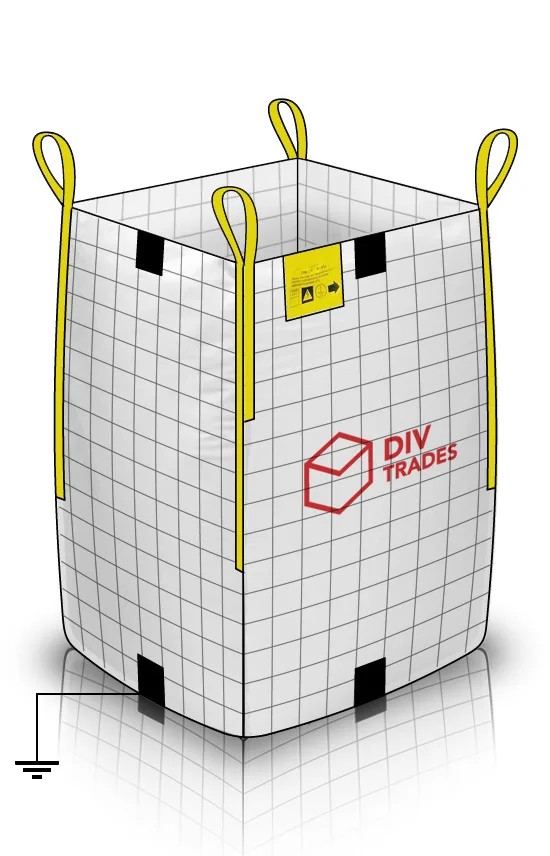
Quick facts
- Type B and Type C to IEC 61340-4-4 Ed. 2.0
- Type C: resistance below 10⁷ ohm between any two points
- Breakdown voltage and conductivity tested on fabric and finished bags
- Yellow or white conductive loops, black grounding points
- Yellow Type C label on every bag
Conductive big bags, also called antistatic big bags, are FIBC that prevent electrostatic discharge while a bag is filled or emptied. When bulk material rubs against polypropylene fabric, an electric charge builds up; a spark can ignite flammable dust, gas or vapor. DIV Trades manufactures Type B and fully conductive Type C big bags according to IEC 61340-4-4 Ed. 2.0 for chemical, pharmaceutical and food producers across Europe.
When do you need a conductive FIBC?
Two situations carry a risk of ignition. The first is an explosive product: whether a conductive bag is needed depends on the minimum ignition energy (MIE) of the material being filled. The second is an explosive environment made up of dust, gases or vapor; gases and vapor present the highest danger. The table below shows which FIBC type is required for each combination.
| Product | Non-explosive environment | Explosive dust (Dust zone 21-22) | Explosive gases or vapor (Gas zone 1-2) |
|---|---|---|---|
| Non-explosive product | Type A | Type B | Type C |
| MIE > 3 mJ | Type B | Type B | Type C |
| MIE < 3 mJ | Type C | Type C | Type C |
The four FIBC types: A, B, C and D
Type A
No special electrical properties. Most big bags in industry are Type A, and a bag is Type A unless the specification says otherwise.
Type B
Made from Type B fabric with a breakdown voltage below 6 kV, which reduces the chance of heavy brush discharges. Suitable for explosive dust zones with non-explosive or low-sensitivity products.
Type C (conductive)
Fully conductive. Black carbon threads are woven into the fabric and all parts of the bag are joined by conductive interconnections, so the resistance between any two points is below 10⁷ ohm. One of the black grounding points must be earthed during filling and discharging; some rigs ground the bag via the loops instead. Electrical charge on the bag is effectively eliminated.
Type D
Does not need grounding but releases its charge to the surroundings by corona discharge, so every person and object around the bag must be grounded. DIV Trades does not currently offer Type D FIBC.
How DIV Trades builds a Type C big bag
- Conductive PP fabric with black carbon threads woven in, produced in our own weaving plant; see technical textiles.
- Body, loops, spouts, skirts and baffles connected by conductive interconnections so the whole bag is one conductive system.
- Special loop material with a carbon strip; Type C loops are usually yellow or white.
- Black grounding points on the bag for the earthing clamp.
- Conductive PE inliner for Type B and Type C big bags with inliners.
- A yellow extra label with the relevant electrical information on every conductive bag.


Testing conductive big bags
DIV Trades measures both the breakdown voltage and the conductivity of the fabric and of the finished Type C big bags. See quality management for the certified management system behind this testing.
What happens if the wrong bag is used?
Grounding is not optional
If no suitable bag is used, or if a Type C bag is not grounded correctly, the worst case is an explosion in your or your customer's plant, with financial and personal damage. To our knowledge no major accident caused by a discharge from an FIBC has ever happened, and correct bag selection and grounding keep it that way.
Filling and discharging options
Conductive big bags take every inlet and outlet: inlet spout, skirt, outlet spout, flat bottom and more, all with conductive interconnections. They can also be formstable, foodclean or UN certified. See filling options and discharging options.

What is the difference between Type B and Type C big bags?
Type B fabric has a breakdown voltage below 6 kV and limits heavy discharges but is not conductive. Type C fabric contains woven carbon threads, every part of the bag is interconnected and the bag must be grounded, which removes the charge entirely.
Does a Type C big bag have to be grounded?
Yes. One of the grounding points, or the loops on rigs designed for it, must be connected to earth during filling and discharging. An ungrounded Type C bag offers no protection.
What is MIE?
MIE is the minimum ignition energy of a dust or product in millijoules. Products with an MIE below 3 mJ always require a Type C bag; products above 3 mJ require Type B or Type C depending on the environment.
Can a conductive big bag have an inliner?
Yes. Type B and Type C bags with liners use a special electro-conductive PE inliner so the liner does not isolate the product from the conductive fabric.
Does DIV Trades supply Type D big bags?
No. DIV Trades currently offers Type A, Type B and Type C FIBC.
Request a quote for Type C big bags
Tell us your product, its MIE if known, and the zone classification of your filling and discharging area. Our sales team will recommend Type B or Type C and the right construction.
Request a quote